
How I Build Morning Sun in an Overcast Kitchen
This kitchen, with a Lacanche range, was photographed on an overcast morning. The windows sit at a 90-degree angle to the camera, and the plain version, shown first, is beautiful and accurate. It's exactly what the room looks like on a gray day. But a design has more to say than a gray day lets it. So I made a second version.
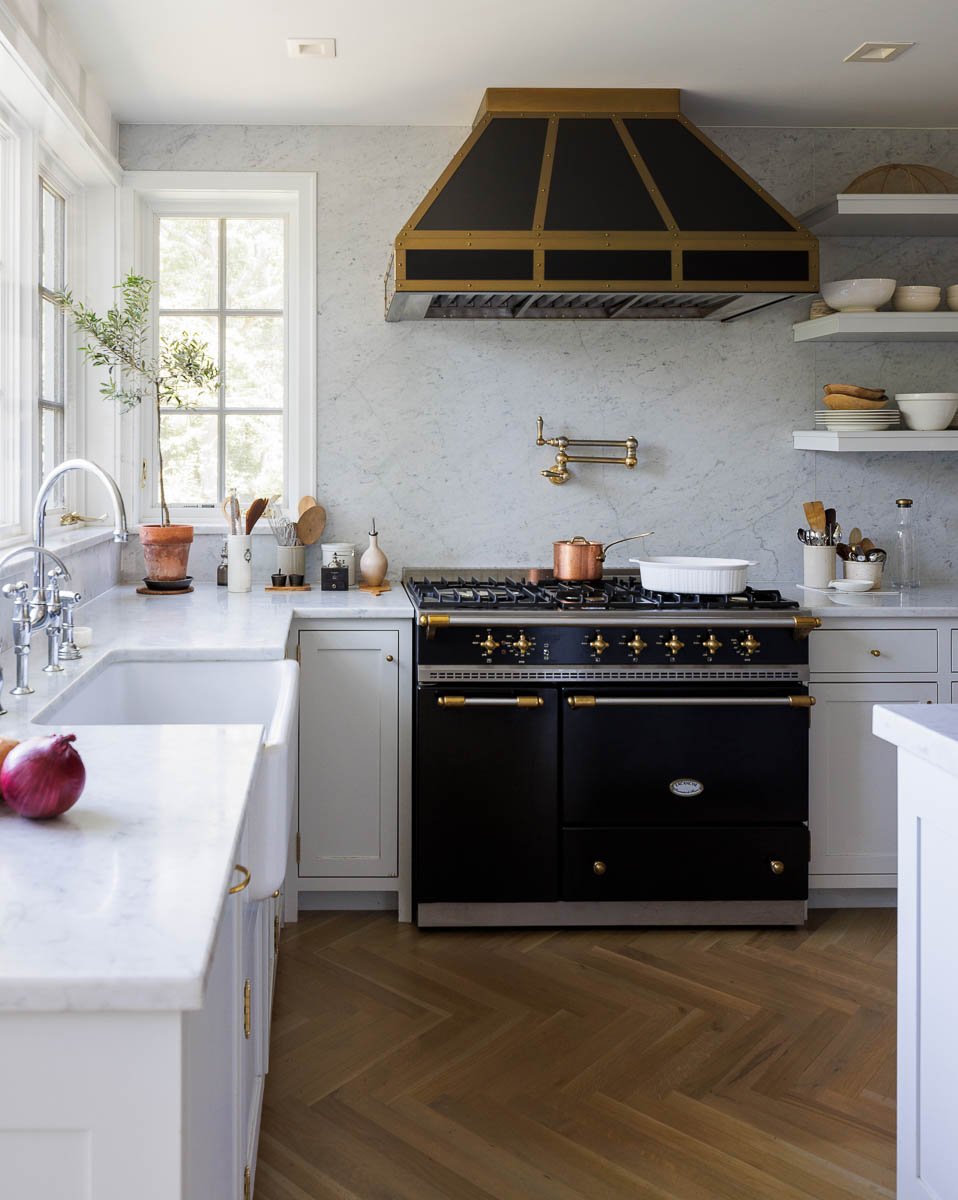
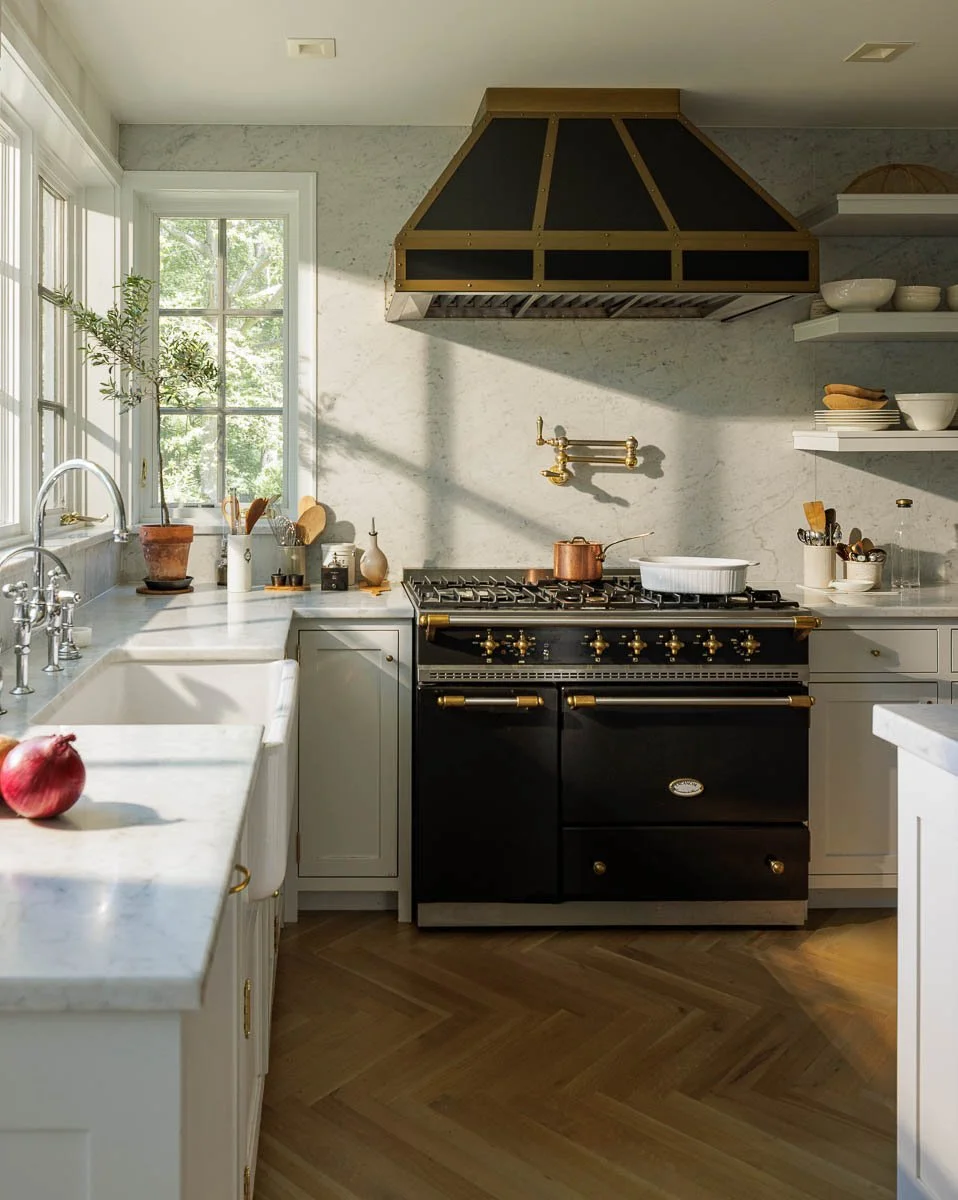
What changed?
I placed a 600-watt strobe at full power on an extra tall light stand outside the window, warmed it with a CTO gel, and aimed it so the window mullions fall across the marble backsplash. The shadow pattern lands around the brass pot filler, so the eye goes straight to it. The warm light also reaches the herringbone floor and the brass details on the range and hood. Nothing in the room moved. The only difference is the direction and color of the light.
Why it works Light direction matters more than any other factor in a photograph. Light that rakes across a surface at a steep angle, around 45 to 90 degrees, reveals texture and depth. Light from behind the camera flattens a room. An overcast sky gives soft, even light with no direction at all, and that's where a strobe can help. Windows and doors are fixed, so you can't move them to get better light.
A strobe lets me supply the direction to accentuate the architecture and design. Both versions go to the client I deliver proofs of the plain capture and the "morning sun" version. About 90% of the time, clients choose the sun. The room has a mood, a time of day, and a sense that someone is about to start cooking.
Tips! If you shoot your own progress photos, you probably won't have strobes, but you can still use the principle:
Know when the sun arrives. I use the Sun Surveyor iPhone app to see when sunlight will hit which part of a building or come through a window. Check it before you schedule a shoot.
Turn off the interior lights so you're working with a single color temperature.
Shoot when the sun comes in at a steep angle to the surfaces you want to show.
Try to avoid shooting into a window or with light directly behind you, if you can.
And if the sun isn't out, I can make it, as long as the room is on the first floor. I've done it on overcast mornings and once in the rain, with plastic trash bags protecting the strobe. For upper floors, we would have to rent a scissor lift.
If you'd like images like the morning-sun version for your own project, get in touch.
Kitchen range: Lacanche
Architecture & Design: MZ Architects